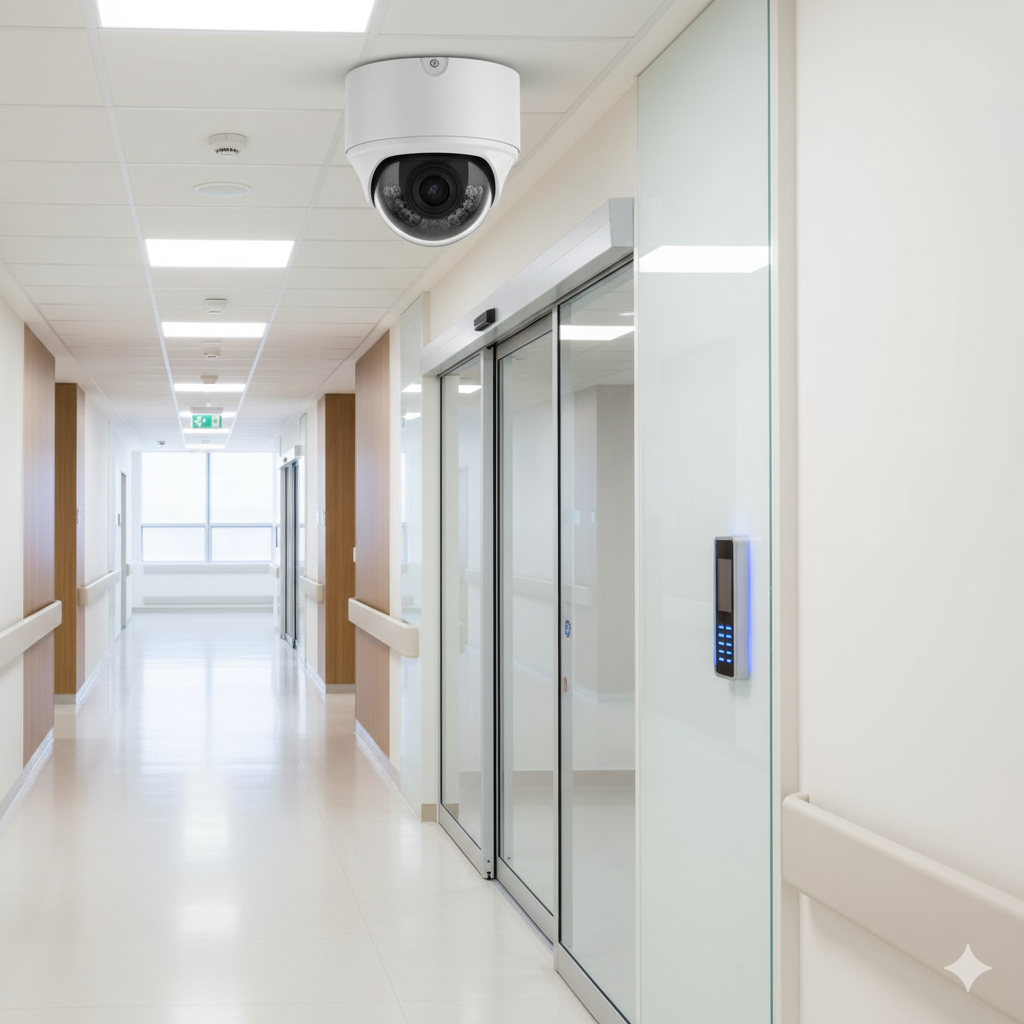
Healthcare facilities are some of the most complex environments to secure in the entire commercial building world. You are protecting patients, staff, visitors, controlled substances, expensive medical equipment, and sensitive patient records — all inside buildings that need to remain open and welcoming to the public 24 hours a day. That combination of open accessibility and critical security requirements is what makes healthcare security fundamentally different from every other industry.
The stakes are enormous. The Joint Commission reported that hospitals experience an average of 8 to 12 violent incidents per month. Workplace violence in healthcare is four times higher than any other private sector industry according to OSHA. And those are just the safety threats. On the compliance side, HIPAA physical safeguard violations carry penalties of $100 to $50,000 per violation with annual maximums of $1.5 million per violation category. A single unsecured server room or improperly controlled access point to a medical records area can trigger six-figure penalties.
At Security Dynamics Inc., we have been designing and installing healthcare facility security systems across New Jersey for 37 years. We hold NJ Burglar Alarm License #34BA00089500 and NJ Fire Alarm License #P00747, and we have secured medical offices, urgent care centers, outpatient surgical facilities, rehabilitation centers, and multi-building hospital campuses. This guide covers every component your healthcare facility needs, HIPAA physical safeguard requirements, access control strategies for restricted areas, video surveillance best practices, NJ-specific healthcare regulations, costs by facility type, and what Security Dynamics delivers on every healthcare project.
Why Healthcare Security Is Different from Standard Commercial Security
A medical office is not a regular office. A hospital is not a warehouse. The security challenges in healthcare are driven by regulatory mandates, patient safety obligations, and operational realities that do not exist in any other industry. Here is what makes healthcare security unique:
Regulatory Compliance Drives Every Decision
HIPAA, The Joint Commission, CMS Conditions of Participation, OSHA workplace violence standards, DEA controlled substance regulations, and NJ Department of Health facility licensing requirements all impose specific physical security mandates. A healthcare security system is not just about preventing theft and unauthorized access — it must satisfy auditors and regulators who will inspect every door, every camera, every access log, and every alarm zone. Systems that work perfectly in other commercial settings fail healthcare compliance reviews because they were not designed with these regulations in mind.
Open Access Conflicts with Security Requirements
Healthcare facilities must remain welcoming and accessible to patients, families, and visitors while simultaneously restricting access to medication storage, medical records, server rooms, surgical suites, and behavioral health units. This creates a security architecture challenge that does not exist in buildings where you can simply lock the front door. You need layered access control that feels seamless to authorized personnel and invisible to patients while being completely impenetrable to unauthorized individuals.
Workplace Violence Is a Daily Threat
Emergency departments, behavioral health units, and waiting areas see more violent incidents than almost any other workplace environment. Staff need duress alarms, panic buttons, and security response systems that work instantly and reliably. Camera coverage must be comprehensive enough to support incident investigation and prosecution. And all of this needs to work without making patients feel like they are in a prison.
24/7 Operations with Constantly Changing Staff
Hospitals never close. Shift changes happen three times a day. Traveling nurses, temporary staff, contractors, and vendor technicians need different levels of access on different schedules. Managing credentials for a constantly rotating workforce requires sophisticated access control systems that can handle complex scheduling and instant credential revocation — not the simple badge-in, badge-out systems that work in regular office buildings.
HIPAA Physical Safeguard Requirements
HIPAA is the regulatory foundation for healthcare security. While most people think of HIPAA as a data privacy regulation, the Physical Safeguards standard (45 CFR 164.310) imposes specific requirements on the physical security of any location where electronic protected health information (ePHI) is created, received, maintained, or transmitted. This includes:
Facility Access Controls (Required)
HIPAA requires covered entities to implement policies and procedures to limit physical access to electronic information systems and the facilities where they are housed. This translates to:
- Contingency operations procedures — Documented procedures for facility access during emergencies while still protecting ePHI
- Facility security plan — Policies and procedures to safeguard the facility and equipment from unauthorized access, tampering, and theft
- Access control and validation — Procedures to control and validate access based on a person's role or function
- Maintenance records — Documentation of repairs and modifications to physical security components (doors, locks, walls)
Workstation Use and Security (Required)
Every workstation where ePHI can be accessed must have physical safeguards that restrict access to authorized users. This means screen positioning, privacy screens, automatic lockouts, and physical access controls for areas containing workstations. Open nursing stations visible to the public hallway need different controls than back-office billing departments.
Device and Media Controls (Required)
Server rooms, data closets, and any location housing hardware or media containing ePHI must have access controls, movement tracking, and disposal procedures. This is where access control systems with full audit trails become critical — HIPAA auditors will ask to see who accessed the server room, when, and for how long.
What Auditors Actually Look For
During HIPAA audits, inspectors focus on physical security gaps that organizations commonly miss:
- Server room and data closet doors that prop open or lack access logging
- Medical records storage areas without controlled access
- Workstations in public areas without privacy controls or auto-lock
- Backup media storage locations without physical access controls
- Visitor management gaps — can visitors access restricted areas unescorted?
- Access control audit trail gaps — can you prove who accessed what area and when?
- Missing documentation of physical security policies and procedures
Access Control for Healthcare Facilities
Access control is the most critical security component in any healthcare environment. It enforces regulatory compliance, protects patients and staff, controls access to controlled substances, and generates the audit trails that regulators demand. Here is how access control should be implemented across different healthcare areas:
Emergency Department Access Control
The ED is the highest-risk area in most healthcare facilities. It is open to the public, handles the most volatile patients, and sees the highest incidence of workplace violence. Access control in the ED must include:
- Controlled entry vestibule — Double-door mantrap or interlock system at the main entrance with video intercom
- Staff-only zones — Badge access for treatment areas, medication rooms, and staff corridors
- Duress buttons — Fixed panic buttons at triage, registration, and each treatment bay, plus mobile duress pendants for nurses
- Elopement prevention — Exit alarms on doors that behavioral health patients or confused elderly patients might use to leave
- Lockdown capability — Ability to lock all ED perimeter doors simultaneously from a central point during active threat events
Pharmacy and Medication Storage
DEA regulations (21 CFR 1301.71-76) and NJ Board of Pharmacy rules require specific physical security for controlled substances. This goes beyond standard access control:
- Dual authentication — Two-factor access for controlled substance storage (badge + PIN or badge + biometric)
- Transaction-level logging — Every entry and exit logged with timestamp, user ID, and duration
- Video verification — Camera coverage at every access point to pharmacy and controlled substance storage, with footage retention matching DEA requirements
- Automated dispensing cabinet integration — Access control tied to Pyxis, Omnicell, or similar automated dispensing systems
- After-hours alarm — Intrusion detection on pharmacy perimeter when unoccupied
Behavioral Health and Psychiatric Units
Behavioral health areas require anti-ligature hardware, patient elopement prevention, and special attention to patient safety. Access control in these areas must include:
- Anti-ligature card readers and door hardware — No protrusions that could be used for self-harm
- Patient tracking — RTLS (Real-Time Location System) wristbands that trigger alerts at exit points
- Staff duress integration — Panic buttons that immediately identify the staff member's location
- Delayed egress locks — 15-30 second delay on exit doors with alarm notification (in compliance with NJ fire code)
- Contraband detection — Screening protocols at unit entry points
Nursery and Infant Protection
Infant abduction prevention is a critical security requirement for any facility with a maternity department. Modern infant protection systems include:
- Infant security tags — RFID or RTLS tags attached to the infant that trigger alarms at exit points and elevator lobbies
- Mother-infant matching — Electronic matching systems that alert when an infant is moved away from the assigned mother
- Automatic lockdown — If an infant tag crosses a perimeter zone, all unit doors lock automatically
- Video coverage — Cameras on every corridor, elevator, stairwell, and exit within the maternity area
- Staff badge verification — Only credentialed staff can transport infants between areas
Server Rooms and Data Centers
HIPAA compliance requires controlled, audited access to all locations housing ePHI systems:
- Multi-factor authentication — Badge plus biometric (fingerprint or iris) for server room entry
- Environmental monitoring — Temperature, humidity, and water leak sensors integrated with alert systems
- Video recording — Continuous camera coverage inside the server room with 90+ day retention
- Access scheduling — Time-based restrictions that limit server room access to authorized maintenance windows
- Visitor escort requirements — Vendor and contractor access requires a pre-authorized escort with dual-badge entry
Video Surveillance for Healthcare Facilities
Video surveillance in healthcare serves three critical functions: real-time situational awareness for security staff, evidence for incident investigation and liability protection, and compliance documentation for regulatory audits. Camera placement must balance comprehensive coverage with patient privacy rights.
Where Cameras Are Required
- All exterior entrances and exits — Including emergency exits, loading docks, and ambulance bays
- Parking structures and lots — Full coverage with license plate capture capability at entries and exits
- Emergency department waiting areas and corridors — Coverage of all public areas without capturing treatment areas
- Pharmacy entrances and medication storage areas — High-resolution cameras for DEA compliance
- Stairwells and elevator lobbies — Every floor, every stairwell
- Loading docks and receiving areas — Coverage of all deliveries and material movement
- Corridor intersections — Coverage of major traffic patterns throughout the facility
- Cash handling areas — Cashier stations, billing offices, vending areas
Where Cameras Must NOT Be Placed
Patient privacy is a critical constraint. Cameras are generally prohibited in:
- Patient rooms and treatment areas (except with specific clinical justification and consent)
- Restrooms and changing areas
- Staff break rooms and locker rooms
- Areas where camera coverage would capture protected health information on screens or documents
Camera Specifications for Healthcare
Healthcare environments demand specific camera capabilities:
- Minimum 4MP resolution — Higher in pharmacy and high-security areas for positive identification
- Vandal-resistant housings — IK10 rated in behavioral health and ED areas
- Low-light performance — Corridors and parking areas must maintain usable footage in reduced lighting
- Wide dynamic range — Hospital environments have extreme lighting variations between windowed lobbies and interior corridors
- Audio capability — Two-way audio at controlled entry points and video intercoms
- Analytics integration — Loitering detection, line-crossing alerts, facial recognition for restricted areas
Video Retention Requirements
Healthcare facilities should plan for longer retention periods than standard commercial buildings:
- General areas — 30-90 days minimum
- Pharmacy and controlled substance areas — 90-180 days to align with DEA audit cycles
- Areas with patient interaction — Retention aligned with statute of limitations for medical malpractice in NJ (2 years from discovery)
- Incident footage — Preserved indefinitely when related to an incident, claim, or investigation
Duress and Panic Alarm Systems
Workplace violence alarms are not optional in healthcare — they are a safety necessity and increasingly a regulatory requirement. OSHA has issued specific guidance on workplace violence prevention in healthcare, and NJ adopted workplace violence prevention legislation requiring healthcare employers to implement prevention programs.
Types of Duress Systems
- Fixed panic buttons — Hardwired buttons at registration desks, triage stations, nurse stations, and exam rooms. Silent alarm to security with location identification.
- Mobile duress pendants — Wireless panic devices worn by staff. When activated, the system identifies the staff member and their real-time location within the building via RTLS.
- Workstation duress — Software-based panic buttons on desktop computers or integrated into clinical applications. One click sends a silent alarm with workstation location.
- Phone-based duress — Code words or key sequences on desk phones and mobile devices that trigger silent alarms.
Integration with Lockdown Systems
In an active threat scenario, duress systems should trigger automated responses:
- Automatic door locking in the affected zone
- Mass notification to staff via overhead paging, text alerts, and desktop pop-ups
- Camera views from the affected area automatically pulled up in the security operations center
- Notification to local law enforcement via central station monitoring
- Elevator recall to ground floor or lockout from affected floors
Fire and Life Safety in Healthcare
Healthcare facilities have the most stringent fire code requirements of any occupancy type. NJ follows the International Building Code and NFPA standards, with healthcare facilities classified as Institutional Group I-2 occupancy. Key requirements include:
Fire Alarm System Requirements
- Addressable fire alarm system — Every device individually identified for rapid location of alarms
- Smoke detection in every patient room, corridor, and common area
- Duct smoke detectors — In HVAC systems to prevent smoke spread through ductwork
- Manual pull stations — At every exit and stairwell entrance
- Integration with HVAC and air handling — Automatic shutdown of affected zones on alarm
- Elevator recall — Automatic recall to designated floor on fire alarm
- Central station monitoring — 24/7 monitoring with immediate fire department notification
Sprinkler and Suppression Requirements
- Full building sprinkler coverage — Required for all healthcare occupancies under NJ code
- Clean agent suppression — For server rooms, data centers, and MRI suites where water would cause catastrophic damage
- Kitchen hood suppression — Separate suppression system for commercial kitchens and cafeterias
- Operating room considerations — Special suppression requirements for surgical suites with medical gases
Emergency Communication
- Code Blue, Code Silver, Code Pink systems — Standardized hospital emergency codes with mass notification integration
- Overhead paging with zone control — Ability to page specific areas without alarming the entire facility
- Text and app-based alerts — Push notifications to staff mobile devices with specific instructions by code type
- Two-way radio integration — Security and clinical staff radio systems integrated with alarm and lockdown triggers
Healthcare Security System Costs by Facility Type
Healthcare security costs vary dramatically based on facility type, size, regulatory requirements, and the level of integration needed. Here are realistic cost ranges based on Security Dynamics project experience in New Jersey:
| Facility Type | Typical Size | Cost Range | Key Components |
|---|---|---|---|
| Single-physician medical office | 1,000-3,000 sq ft | $5,000-$15,000 | Access control, 4-8 cameras, intrusion alarm, HIPAA-compliant server room lock |
| Multi-provider medical office | 3,000-10,000 sq ft | $15,000-$45,000 | Card access on all exterior and restricted doors, 8-16 cameras, duress buttons, fire alarm |
| Urgent care center | 3,000-8,000 sq ft | $20,000-$50,000 | Controlled entry vestibule, panic alarms, pharmacy-grade medication storage security, video surveillance |
| Outpatient surgical center | 5,000-20,000 sq ft | $35,000-$80,000 | Sterile zone access control, medication security, pre/post-op monitoring, fire suppression |
| Rehabilitation facility | 10,000-50,000 sq ft | $40,000-$120,000 | Elopement prevention, wander management, pharmacy security, perimeter control |
| Behavioral health facility | 10,000-40,000 sq ft | $50,000-$150,000 | Anti-ligature hardware, RTLS patient tracking, duress systems, delayed egress, contraband screening |
| Community hospital | 50,000-200,000 sq ft | $150,000-$500,000+ | Enterprise access control, hundreds of cameras, infant protection, pharmacy security, lockdown, fire alarm |
These ranges include equipment, installation, programming, and integration. They do not include ongoing monitoring fees (typically $150-$500/month for healthcare facilities depending on alarm zones and monitoring complexity) or annual maintenance contracts.
NJ-Specific Healthcare Security Regulations
New Jersey has several state-specific requirements that affect healthcare facility security beyond federal HIPAA and Joint Commission standards:
NJ Department of Health Facility Licensing
- N.J.A.C. 8:43G — Hospital licensing standards including physical plant security requirements
- N.J.A.C. 8:43A — Ambulatory care facility standards with security provisions
- N.J.A.C. 8:36 — Long-term care facility standards including resident safety and elopement prevention
- N.J.A.C. 8:43J — Behavioral health facility standards with specific security mandates for patient safety
NJ Workplace Violence Prevention
New Jersey's Violence Against Healthcare Professionals Act (P.L. 2008, c.100) enhances penalties for assaults against healthcare workers. While primarily a criminal statute, it underscores the legal expectation that healthcare facilities provide adequate security. Facilities that fail to implement reasonable security measures face increased civil liability exposure when staff are injured.
NJ Controlled Substance Requirements
The NJ Board of Pharmacy enforces specific physical security requirements for controlled substance storage that go beyond federal DEA minimums. NJ-registered pharmacies and healthcare facilities dispensing controlled substances must maintain:
- Substantially constructed storage (steel or reinforced concrete)
- Alarm systems with central station monitoring
- Access limited to specifically authorized personnel
- Audit trails documenting every access event
NJ Fire Code for Healthcare Occupancies
NJ adopts NFPA 101 Life Safety Code with state amendments. Healthcare occupancies (new and existing) must comply with Chapters 18 and 19 respectively, including:
- Automatic sprinkler protection throughout
- Addressable fire alarm with smoke detection
- Defend-in-place evacuation strategy (not full building evacuation)
- Smoke compartmentalization with automatic door releases
- Annual fire system inspection and testing with NJ-licensed fire alarm contractors
Choosing a Healthcare Security Integrator
Healthcare security is not a commodity product. The integrator you choose must understand healthcare regulations, patient privacy requirements, clinical workflows, and the unique operational challenges of medical facilities. Here is what to look for:
Must-Have Qualifications
- NJ burglar and fire alarm licenses — Required by law for any company installing alarm systems in New Jersey
- Healthcare-specific experience — Ask for references from similar facility types
- HIPAA awareness — The integrator should understand physical safeguard requirements and design systems that satisfy compliance
- UL-listed central station monitoring — Required for code compliance and insurance
- factory-trained technicians — Fire alarm design and installation by nationally certified professionals
- 24/7 service capability — Healthcare facilities cannot wait until Monday for a broken access control system
Red Flags to Avoid
- Integrators who have never worked in healthcare and do not understand HIPAA physical safeguards
- Proposals that do not address regulated areas (pharmacy, server room, behavioral health) separately
- Systems that cannot generate HIPAA-compliant audit trails
- No mention of anti-ligature hardware for behavioral health areas
- Cookie-cutter proposals that look identical to their office building packages
- No ongoing maintenance or monitoring plan
What Security Dynamics Delivers for Healthcare Clients
Security Dynamics Inc. approaches every healthcare project with the understanding that security in medical facilities is a patient safety and regulatory compliance issue, not just a property protection issue. Here is what we deliver:
- Compliance-first design — Every system designed to satisfy HIPAA, Joint Commission, NJ DOH, DEA, and OSHA requirements from day one
- Healthcare workflow integration — Access control and alarm systems designed around clinical workflows so security enhances operations instead of creating friction
- Full audit trail capability — Every access event, alarm event, and camera view logged and exportable for compliance audits
- Scalable architecture — Systems built on enterprise platforms that grow with your facility without rip-and-replace
- NJ licensed and insured — Burglar alarm license #34BA00089500, fire alarm license #P00747, with factory-trained technicians
- 24/7 emergency service — Healthcare security systems cannot be down. We provide true 24/7 emergency response for all healthcare clients
- Ongoing compliance support — We help prepare for Joint Commission surveys, HIPAA audits, and NJ DOH inspections by ensuring your physical security documentation and systems are audit-ready
Getting Started
If you operate a healthcare facility in New Jersey or Eastern Pennsylvania and need a security assessment, Security Dynamics provides complimentary facility security evaluations for healthcare clients. We will walk your facility, identify compliance gaps, document vulnerabilities, and provide a detailed proposal covering recommended systems, costs, and implementation timeline.
Call us at (609) 394-8800 or request a free security assessment online. We have been protecting New Jersey businesses since 1989, and healthcare security is one of our core specialties.